Physical Address
304 North Cardinal St.
Dorchester Center, MA 02124
Physical Address
304 North Cardinal St.
Dorchester Center, MA 02124

In the current landscape of paid social, the traditional bottleneck has shifted. It is no longer about precision targeting—algorithms on Meta and TikTok have largely solved the “who”—but about the creative “what.” For performance marketers, the primary enemy is creative fatigue. A winning asset that delivers a 3.0 ROAS on Monday can often decay to a 1.2 by the following Thursday as the audience saturates and the algorithm demands fresh stimuli.
The structural failure in many marketing departments is the speed of the production cycle. If it takes three weeks to brief, shoot, and edit a high-fidelity video ad, and that ad only has a shelf life of seven days in a high-spend environment, the math for scaling simply does not work. To maintain efficiency, the workflow must transition from a “big bet” cinematic approach to a high-velocity testing engine. This is where an AI Video Generator changes the operational calculus, allowing teams to treat video assets as modular, iterative data points rather than static art projects.
Creative fatigue is a psychological reality of the infinite scroll. When users see the same visual hook repeatedly, their “thumb-stop” response diminishes. In high-spend accounts, this decay happens with brutal speed. The traditional response has been to increase production budgets, but higher costs per asset actually make the problem worse by raising the stakes for every single video.
When you are locked into a traditional workflow, every creative decision is precious. You spend days debating the color of a background or the specific pacing of a transition because the cost of “getting it wrong” is high. This creates a structural lag. By the time a creative team analyzes the performance data from one campaign and produces a “V2,” the trend has likely passed or the audience’s taste has shifted.
The goal should be to decouple the volume of creative testing from the hours spent in a studio. By using an AI Video Generator to handle the heavy lifting of visual production, the marketing team moves from being content creators to being creative systems operators. The focus shifts from “How do we make one great video?” to “How do we generate fifty variations to find the three that actually convert?”
To effectively scale, marketers should adopt a modular “Hook-Body-CTA” framework. In this model, an ad is not a monolithic file, but a combination of three distinct segments. The “Hook” (the first 3 seconds) is responsible for the thumb-stop rate; the “Body” handles the value proposition and social proof; and the “CTA” drives the click.
Using a multi-model platform like MakeShot, performance teams can rapidly iterate on the Hook. For example, you might use the Kling or Veo models to generate five different visual textures for the same product concept—one that looks like 90s lo-fi camcorder footage, another that is sleek and cinematic, and a third that uses abstract motion.
It is important to acknowledge a current limitation here: AI video models still struggle with precise brand consistency across long durations. If you need a character to wear the exact same logo-etched jewelry in every frame for 30 seconds, the technology will likely introduce slight “hallucinations” or morphing. However, for 3-second hooks where the goal is simply to arrest the user’s attention, these variations are an asset, not a liability. By testing 20 different AI-generated hooks against a single “control” body and CTA, marketers can identify which visual triggers are currently resonating with the algorithm’s selected sub-audience.
While the potential for scale is massive, the “uncanny valley” remains a significant hurdle. Performance marketers must exercise practical judgment when deciding which elements to delegate to an AI Video Generator and which to keep manual.
Currently, AI excels at “safe zones” such as atmospheric backgrounds, stylized B-roll, abstract motion graphics, and product-focused close-ups where human anatomy isn’t the primary focus. If you are selling a physical product, generating a stylized environment for that product to sit in is a low-risk, high-reward use of the tool.
Conversely, high-risk zones involve complex human facial expressions and specific synchronized movements like speaking to the camera. We are currently in a state of uncertainty regarding how audiences will respond to fully synthetic “UGC” creators over the long term. While some early data suggests synthetic creators can convert in the short term, there is a risk of brand erosion if the “fake” nature of the video becomes distracting.
A more sustainable strategy is the “Hybrid Workflow.” This involves taking real UGC—filmed on a phone for authenticity—and using AI tools to swap out backgrounds, add surreal visual effects, or generate B-roll cutaways. This grounds the ad in human reality while leveraging the speed of generative tools to keep the visual interest high.
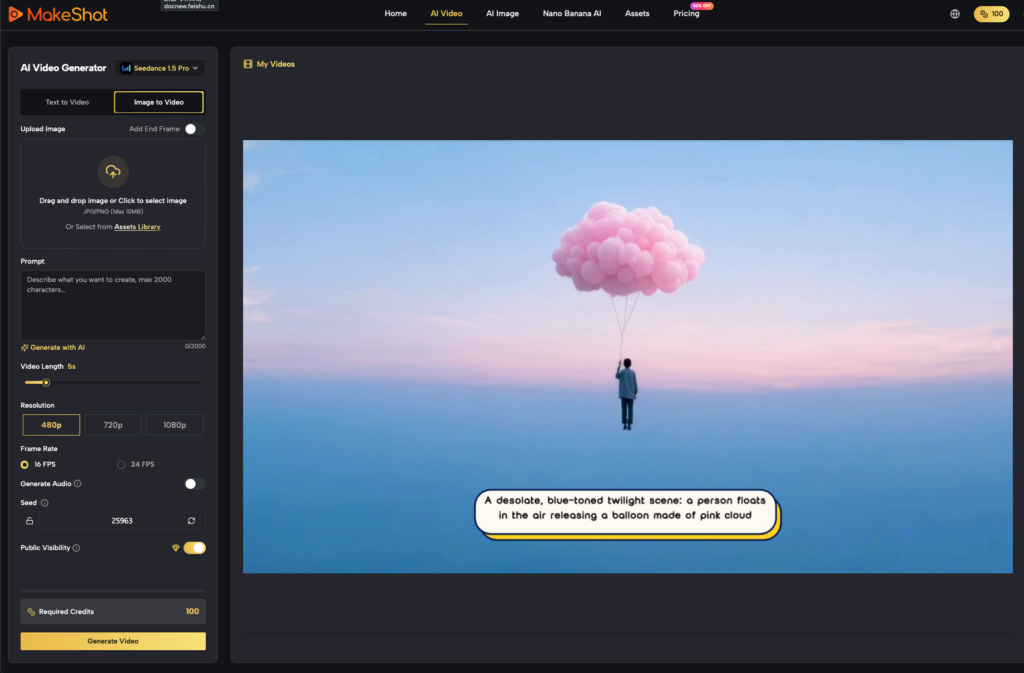
The real power of generative video is realized when the feedback loop between the ad manager and the prompt bar is closed. In a traditional setup, the media buyer sees a low Click-Through Rate (CTR) and tells the creative team, “We need more energy.” In an AI-driven workflow, the media buyer looks at the “Thumb-Stop Rate” (the percentage of people who watched at least 3 seconds) and directly informs the next batch of prompts.
If data shows that “surrealist nature” hooks are outperforming “urban minimalist” hooks by 40%, the team can immediately generate ten more variations of the surrealist concept.
The choice of the underlying model within the platform also matters. For instance, using a model like Kling might be better for high-motion, fluid transitions, whereas a different model might be preferred for high-detail, static-to-motion image animation. Understanding the nuances of these models allows a creative strategist to “cast” the right AI for the right performance goal.
This level of iteration isn’t just about efficiency; it’s about statistical probability. If you test 5 assets a month, your chances of finding a “unicorn” ad are slim. If you use generative tools to test 50 variations a week, you are almost guaranteed to find outliers that significantly reduce your Cost Per Acquisition (CPA).
We are moving toward a period where creative assets are no longer “finished” products but are instead “just-in-time” responses to market data. The role of the Creative Strategist is evolving. The job is no longer to direct a camera crew, but to manage a pipeline of generative models and interpret the performance data they produce.
The competitive gap is widening between those who view AI as a “shortcut” and those who view it as a “testing engine.” The former will use an AI Video Generator to make one cheap ad and wonder why it didn’t go viral. The latter will build a system that produces a constant stream of modular variations, systematically killing the “losers” and doubling down on the “winners.”
Ultimately, the goal of integrating AI into the campaign workflow is to remove the guesswork. By the time a campaign is scaled to its full budget, the creative should have already survived a brutal, high-velocity testing phase where only the most engaging hooks remain. This isn’t just a change in toolsets; it’s a fundamental shift in the economics of attention. As the cost of generating a single frame of video approaches zero, the value of the strategist who knows exactly which frames to generate and why will only continue to rise.